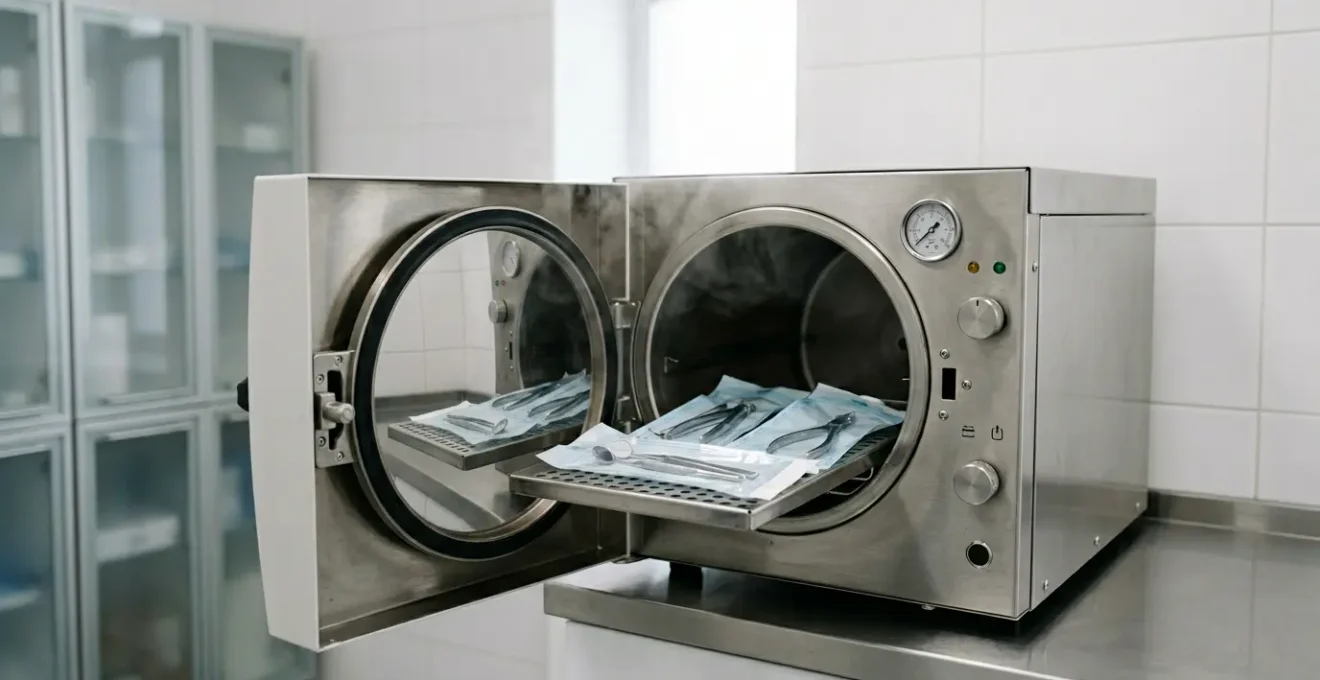
The reassuring truth is that true dental safety isn’t about what you can see; it’s about defeating invisible, highly resilient threats through a validated scientific process.
- Unlike simple boiling, autoclaving uses pressurized steam to reach temperatures that destroy even the hardiest viruses, like Hepatitis B.
- The process is a “chain of sterility,” where proper use, verification with spore tests, and correct storage are as crucial as the machine itself.
Recommendation: Feel confident in your care by understanding that the use of an autoclave signifies a commitment to the highest, non-negotiable standard of patient protection.
Settling into a dental chair, it’s natural for your eyes to scan the environment. You notice the clean surfaces and the tools laid out on a tray, and a faint, anxious thought might cross your mind: “Are these instruments *really* clean?” You might assume that a thorough wash or a boil is enough to ensure safety. After all, isn’t that how we disinfect things at home? This common assumption, however, overlooks the microscopic world of highly resilient pathogens that pose a genuine risk of cross-contamination.
The reality of medical and dental hygiene goes far beyond visible cleanliness. It involves a battle against an unseen enemy, where some opponents, like the Hepatitis B virus, are notoriously difficult to defeat. This is where the quiet, unassuming work of a sterilization technician and the power of a medical autoclave come into play. The process is not merely about washing; it’s a science of eradication. True safety doesn’t come from a simple wipe-down but from a validated, multi-step protocol designed to achieve complete sterility.
But if simple cleaning isn’t enough, what makes the autoclave so indispensable? The key lies in understanding that not all sterilization methods are created equal. This article will deconstruct the science behind the scenes. We will explore why pressurized steam succeeds where boiling water fails, how professionals verify that every single microbe is killed, and why the “chain of sterility”—from the autoclave to the patient—is a process with zero tolerance for error. It’s a journey into the unseen protocols that form the bedrock of your safety.
To fully grasp the critical importance of these procedures, this guide breaks down the essential components of medical sterilization. The following sections will walk you through the science, the standards, and the practical realities that ensure every instrument is completely safe for use.
Summary: The Complete Guide to Medical Sterilization and Patient Safety
- Why Boiling Water Is Not Enough to Kill Hepatitis B on Tools?
- How to Spot if a Tattoo Parlour Has Valid Sterilisation Certificates?
- Single-Use vs Autoclaved Tools: Which Is Better for the Environment?
- The Instrument Storage Error That Contaminates Sterile Packs
- How Often Should Medical Autoclaves Be Serviced to Ensure Safety?
- UK Standards vs Turkey Clinics: Which Is Safer for Hair Transplants?
- Single-Use vs Reusable: Is Disposable Really Better for Safety?
- Why Surgical Instruments Cost £5,000 When You Can Buy Similar Tools at Hardware Stores
Why Boiling Water Is Not Enough to Kill Hepatitis B on Tools?
The primary reason autoclaves are non-negotiable in a medical setting is their ability to destroy what other methods cannot: highly resistant microorganisms. At the top of this list are bacterial spores and hardy viruses like Hepatitis B (HBV). While boiling water at 100°C (212°F) kills most common bacteria, it falls short against these tougher threats. The issue is one of microbial resilience. Some pathogens have evolved protective shells or complex structures that allow them to withstand extreme conditions.
HBV, for instance, is exceptionally durable. According to Eike Steinmann, a leading researcher on virus stability, its hardiness is remarkable. In a report for ScienceDaily, he notes:
At room temperature, hepatitis B viruses (HBV) remain contagious for several weeks and they are even able to withstand temperatures of four degrees centigrade over the span of nine months.
– Eike Steinmann, ScienceDaily report on Hepatitis B virus stability
This resilience extends to high temperatures. An autoclave doesn’t just use heat; it combines it with intense pressure. This allows steam to reach temperatures of 121-134°C (250-273°F), far exceeding boiling point. At this temperature and pressure, the steam can penetrate the defenses of spores and viruses, denaturing their proteins and rendering them inert. Research confirms that boiling is insufficient; one study showed that while HBV could be inactivated at 98°C, it required five full minutes, whereas initial exposure was not enough. The autoclave’s validated cycle ensures a complete kill every time, leaving no room for survival.
How to Spot if a Tattoo Parlour Has Valid Sterilisation Certificates?
While this guide focuses on dental settings, the principles of sterilization are universal and apply equally to other environments where skin is penetrated, such as tattoo parlours or cosmetic clinics. A patient’s or client’s safety depends entirely on the provider’s adherence to these strict protocols. So, how can you, as a consumer, verify that a facility is taking sterilization seriously? You need to look for evidence of sterilization assurance, which is the system of checks that proves the process works.
You shouldn’t just look for a clean-looking shop; you should ask to see their records. A professional and compliant studio will be proud to show you their logbooks. The most important of these is the record of their spore tests, which are the gold standard for verifying an autoclave’s effectiveness. This test involves processing a vial containing highly resistant bacterial spores (like the one pictured below) and then sending it to a lab to confirm they were killed. This is the only way to be certain the autoclave is functioning correctly.
As this image of a biological indicator shows, these tests provide a definitive pass/fail result. A logbook full of consistent, passing results from an independent lab is the best proof of a commitment to safety. Asking to see this documentation empowers you as a consumer and ensures you are in a facility that prioritizes your health over convenience.
Your Action Plan: Verifying a Studio’s Sterilization Practices
- Ask to see the logbook: Inquire about their biological monitoring (spore test) system. These tests should be performed at least monthly and the results verified through an independent laboratory.
- Identify the autoclave type: Confirm they use a Class B autoclave, which is required for sterilizing hollow instruments like needles, as its vacuum cycle ensures steam penetrates all surfaces.
- Check the records retention: Spore test records should be maintained on-site for a minimum of two to three years and be readily available for your inspection.
- Inquire about failure protocols: Ask if the facility has a documented procedure for what happens after a positive spore test, which should include immediately stopping use of the autoclave and notifying clients if necessary.
Single-Use vs Autoclaved Tools: Which Is Better for the Environment?
The debate between single-use, disposable instruments and reusable, autoclaved ones is complex, especially when considering environmental impact. At first glance, disposables seem inherently wasteful, contributing to landfill and plastic pollution. However, the alternative—reprocessing reusable tools—is not without its own environmental footprint. The decision involves a trade-off between material waste and energy consumption.
A single-use instrument, like a disposable syringe or a plastic prophy angle, is manufactured, packaged, shipped, used once, and then discarded, typically as medical waste. This creates a linear path to landfill, consuming raw materials and generating significant refuse. The appeal of single-use items is their guaranteed sterility straight from the package, eliminating any risk of human error in the cleaning and sterilization process. They offer convenience and a high degree of infection control confidence.
On the other hand, autoclaving reusable instruments is a circular process. It requires a significant upfront investment in high-quality tools designed to withstand hundreds of sterilization cycles. The environmental cost here comes from the resources needed for reprocessing: water for cleaning, detergents and chemicals, and, most notably, the electricity and purified water consumed by the autoclave during each cycle. A typical autoclave cycle is energy-intensive. Therefore, the choice isn’t simply between “wasteful” and “green.” It’s a calculation balancing material consumption against energy and water usage.
The Instrument Storage Error That Contaminates Sterile Packs
Achieving sterility inside an autoclave is only half the battle. A perfectly sterilized instrument can be instantly re-contaminated if handled or stored improperly. This is where the concept of the “chain of sterility” becomes critical. Sterility is not a permanent state; it’s a condition maintained only as long as the protective barrier of the sterilization pouch or wrap remains intact. Many people assume these packs have a fixed expiry date, but modern infection control has moved beyond that.
The modern standard is known as event-related sterility. This principle dictates that an item remains sterile indefinitely unless a specific event occurs to compromise its barrier. As explained by Infection Control Today, the focus has shifted from time to handling.
This “event” can be anything that damages the packaging: a tear, a puncture, or exposure to moisture. A water droplet on a sterile pack, as depicted below, acts as a wick, drawing microorganisms from the air and surfaces through the paper barrier, instantly contaminating the contents. This is why proper storage is not a trivial matter—it’s a core pillar of patient safety. Storing packs under a sink, stacking heavy items on them, or dropping them on the floor are all contaminating events.
Therefore, a sterile storage area has strict rules: items must be kept away from walls, floors, and ceilings to allow air circulation, and humidity levels must be controlled. Every package must be inspected for tears, stains, or damage before it is opened. The moment a pack is dropped or becomes wet, it is no longer considered sterile and must be reprocessed. This rigorous attention to detail ensures the sterility achieved in the autoclave is delivered to the patient intact.
How Often Should Medical Autoclaves Be Serviced to Ensure Safety?
An autoclave is a precision machine, and like any high-performance equipment, its reliability depends on a strict regimen of testing and maintenance. Simply running a cycle is not enough; a facility must have proof that each cycle effectively achieved sterilization. This is accomplished through a multi-layered pyramid of monitoring, ranging from checks on every cycle to annual professional servicing. The goal is to catch any potential failure before it can compromise patient safety.
At the base of the pyramid are indicators used with every load. Chemical indicators are strips or markings on sterilization pouches that change color when exposed to certain temperatures. This provides an immediate visual cue that the pack has been through a cycle. Physical indicators are the autoclave’s own gauges and printouts, which log the time, temperature, and pressure of each cycle. These are the first line of defense, but they only confirm that the machine ran—not that it killed anything.
The true test of effectiveness is the biological indicator, or spore test. As mentioned earlier, this is a weekly or monthly test that proves the autoclave’s ability to kill the most resistant life forms. For vacuum-assisted autoclaves, a daily test called a Bowie-Dick test is also performed to ensure the vacuum is removing all air from the chamber, which is essential for proper steam penetration. This consistent testing provides the data needed to trust the machine’s output. When used correctly and properly monitored, the results are definitive; autoclaves can eliminate 99.9999% of spores, providing an exceptionally high level of safety assurance. The final layer is annual professional calibration and preventative maintenance, where a qualified technician inspects and services the entire machine to ensure its continued accuracy and safety.
UK Standards vs Turkey Clinics: Which Is Safer for Hair Transplants?
The rise of medical tourism has made procedures like hair transplants more accessible, with many patients traveling to countries like Turkey for cost savings. However, this raises a crucial question about safety standards, particularly concerning sterilization. While many international clinics operate at a high level, the primary difference in safety often comes down to one factor: regulatory oversight and enforcement. Countries like the United Kingdom have stringent, legally-enforced standards that all clinics must follow.
In the UK, healthcare facilities performing surgical procedures are regulated by the Care Quality Commission (CQC). The CQC conducts inspections and enforces strict guidelines on everything from infection control to staff training. This includes mandatory protocols for instrument sterilization, waste disposal, and maintaining a sterile environment. A clinic’s failure to comply can result in fines, suspension, or closure. This government-level oversight provides a powerful safety net for patients.
This model of national standards is not unique to the UK. As Benco Dental notes when discussing protocols in the United States, adherence to national guidelines is paramount. They state, “In the United States, the Centers for Disease Control and Prevention (CDC) recommends specific protocols for operating autoclaves in dental practices. Following these guidelines is essential for ensuring sterilization effectiveness.” While the regulatory body may differ, the principle is the same: a robust, enforceable national standard provides a baseline of safety. In some destinations for medical tourism, these regulations may be less stringent or inconsistently enforced, placing a greater burden on the patient to vet the clinic’s individual practices, such as their autoclave use and spore testing records.
Single-Use vs Reusable: Is Disposable Really Better for Safety?
The healthcare industry has increasingly trended towards single-use disposable (SUD) items, from surgical gowns to complex medical devices. The logic seems straightforward: a brand-new, sterile item used once and then thrown away eliminates any possibility of cross-contamination from improper reprocessing. This “safety through disposability” model is driven by both efficiency and a deep-seated fear of infection. But is a disposable item always the safer choice?
The answer is more nuanced than it appears. While SUDs offer guaranteed sterility out of the package, the assumption that they are inherently superior to properly reprocessed reusable devices is not always supported by evidence. In a commentary for The Lancet, experts from the Johns Hopkins Bloomberg School of Public Health argue that the reliance on disposables is often based on habit rather than data:
The healthcare industry’s reliance on disposable materials is born out of fear and efficiency, with minimal evidence to support the superiority of some disposable supplies over thoroughly sterilized reusable ones.
– Johns Hopkins Bloomberg School of Public Health, Lancet commentary on medical waste reduction
In fact, when reprocessing is done correctly by regulated third-party companies, the safety profile can be identical to that of a new device. These companies must adhere to strict FDA regulations and validate their cleaning and sterilization processes just as rigorously as the original manufacturer.
Case Study: FDA Safety and Savings from Reprocessed Single-Use Devices
The safety and efficacy of reprocessed SUDs have been scrutinized for decades. According to data from the Association of Medical Device Reprocessors (AMDR), multiple analyses, including one by the independent Government Accountability Office (GAO), have found no increased risk to patients from using FDA-regulated reprocessed devices. The benefits are significant: AMDR members reported that in a single recent year, their work helped US hospitals save over $398 million and prevent 113 million pounds of CO2 equivalent emissions by choosing reprocessed devices over new ones. This demonstrates that with proper regulation, safety and sustainability can coexist.
Key Takeaways
- Sterility is Absolute: An instrument is either 100% sterile or it is contaminated. There is no middle ground, which is why the validated process of autoclaving is essential.
- Verification is Non-Negotiable: True safety comes from proving that sterilization was successful using a combination of chemical, physical, and biological (spore) tests.
- The Chain of Sterility Matters: A sterile instrument is only safe if it remains in its protective packaging until the moment of use. Proper storage and handling are as crucial as the autoclaving process itself.
Why Surgical Instruments Cost £5,000 When You Can Buy Similar Tools at Hardware Stores
When you see a surgical instrument, like a hemostat or a pair of forceps, it might look remarkably similar to a tool you could find in a hardware store for a fraction of the price. This leads to a logical question: what justifies the enormous cost difference? The answer lies in two invisible but critical properties: material integrity and biocompatibility. These factors are central to an instrument’s ability to be safely and repeatedly sterilized.
Surgical instruments are crafted from specific alloys of medical-grade stainless steel. This isn’t the same metal used for household tools. These alloys are formulated for extreme corrosion resistance and to be non-reactive with human tissue (biocompatible). A tool from a hardware store, on the other hand, is typically made from lower-grade steel or may have a chrome plating that can chip and peel over time.
This difference becomes critical inside an autoclave. The combination of high heat, intense pressure, and moisture is incredibly corrosive. As one medical device expert explains, a standard tool simply wouldn’t survive.
Surgical instruments are made from specific medical-grade stainless steel alloys designed for biocompatibility and extreme corrosion resistance. A hardware store tool would rust and develop microscopic pits after one autoclave cycle, creating hiding spots for microbes and making true sterilisation impossible.
– Medical Device Industry Expert, Analysis of medical-grade materials requirements
These microscopic pits and rust patches become perfect hiding places for bacteria and viruses, creating a biofilm that steam cannot penetrate. This makes the instrument impossible to truly sterilize, no matter how many times it’s run through the autoclave. The high cost of a surgical instrument is an investment in a material that can withstand hundreds of harsh sterilization cycles without degrading, ensuring it can be made perfectly sterile for every single patient, every single time.
The next time you settle into the dental chair, you can do so with confidence, knowing the rigorous, unseen process that protects you. Your role is simple: feel empowered to ask questions and choose providers who are transparent about their commitment to these high standards.