
Blaming dating apps for rising STI rates misses the real problem: the silent, asymptomatic nature of most common infections.
- Up to 90% of some common STIs, like gonorrhea in women, show no symptoms, creating hidden transmission chains.
- Effective prevention requires shifting from symptom-watching to proactive strategies like regular testing and responsible partner notification.
Recommendation: Use modern tools like confidential home testing and understand new prevention methods like Doxy-PEP to take control of your sexual health.
It’s a troubling paradox: in an age of unprecedented access to information, rates of sexually transmitted infections (STIs) like chlamydia and gonorrhea are climbing. Public health campaigns have made us more aware than ever, yet the numbers continue to surge. It’s easy to point to modern social dynamics—the rise of dating apps, shifting norms around casual sex—as the sole culprits. While these factors play a role in the speed and scale of transmission, they don’t explain the fundamental vulnerability that allows these infections to thrive.
The real issue lies in a profound mismatch. Our rapidly evolving social and sexual networks are colliding with the ancient, insidious biology of bacteria and viruses that have perfected the art of silent transmission. The uncomfortable truth is that for many STIs, waiting for a symptom to appear before taking action is a failed strategy. These are silent epidemics, spreading invisibly through communities because the infected individuals often feel perfectly healthy. This guide moves beyond blame to uncover the clinical realities fueling this crisis. It’s a deep dive into the “why” behind the statistics, exploring the asymptomatic nature of these infections, the evolution of testing and treatment, and the critical importance of communication to break the chain of transmission.
This article will deconstruct the mechanics of the STI surge, offering a clear path forward. By understanding the true nature of the enemy, we can adopt the proactive strategies necessary to protect ourselves and our communities.
Table of Contents: Unpacking the Silent Surge in STIs
- Why You Can Have Gonorrhea Without Any Symptoms?
- How to Order a Home STI Test Without Seeing a Doctor?
- Single-Dose Antibiotics vs 7-Day Courses: Which Is More Effective?
- The Partner Notification Mistake That Leads to Ping-Pong Infection
- Should Sexually Active People Take Prophylactic Antibiotics?
- Why Doctors Miss Lyme Disease in 40% of Early Cases?
- Why “1 in 5 Diabetics Don’t Know They Have It”
- Why Diabetes Affects 30% of Your Age Group But You Didn’t Know It?
Why You Can Have Gonorrhea Without Any Symptoms?
The single most important factor driving the current STI epidemic is its invisibility. For many infections, particularly gonorrhea and chlamydia, the absence of symptoms is not the exception; it is the rule. Gonorrhea, caused by the bacterium Neisseria gonorrhoeae, has evolved to coexist with its human host without immediately triggering an alarm. It can colonize the mucous membranes of the cervix, urethra, rectum, or throat, replicating and remaining transmissible while causing no pain, discharge, or discomfort.
The statistics are stark and reveal the scale of this silent transmission problem. According to clinical data, up to 90% of urogenital gonorrhea infections in women can be asymptomatic. This means a vast majority of infected women feel perfectly fine and have no biological indication that they are carrying and can transmit a serious infection. In men, symptoms are more common for urethral infections but can still be absent, especially for rectal or pharyngeal (throat) infections.
This asymptomatic nature is the perfect camouflage for an epidemic. It turns individuals into unknowing carriers who continue to engage in sexual activity, inadvertently spreading the infection through their network. It completely bypasses our natural instinct to seek medical care only when we feel sick. This is the core of the transmission mismatch: our social behaviors operate on a much faster, more complex scale than the slow, often non-existent, biological feedback from the infection itself. Relying on symptoms to gauge your STI status is not just unreliable; it’s a dangerous gamble.
How to Order a Home STI Test Without Seeing a Doctor?
Given that most STIs operate in stealth mode, the only effective countermeasure is a shift in mindset: from reactive symptom-watching to proactive testing. For decades, the primary barrier to testing has been the need for an in-person clinic or doctor’s visit, a process often fraught with issues of stigma, inconvenience, and cost. The rise of confidential, reliable at-home STI testing kits is one of the most significant public health developments in recent years, directly addressing the challenge of the silent epidemic.
These services empower individuals to take control of their sexual health on their own terms, in the privacy of their own homes. By removing the gatekeeper of a physical appointment, home testing makes regular screening a feasible part of a routine for anyone who is sexually active, regardless of whether they have symptoms. This is a critical tool for detecting and treating the vast reservoir of asymptomatic infections that fuel the epidemic.
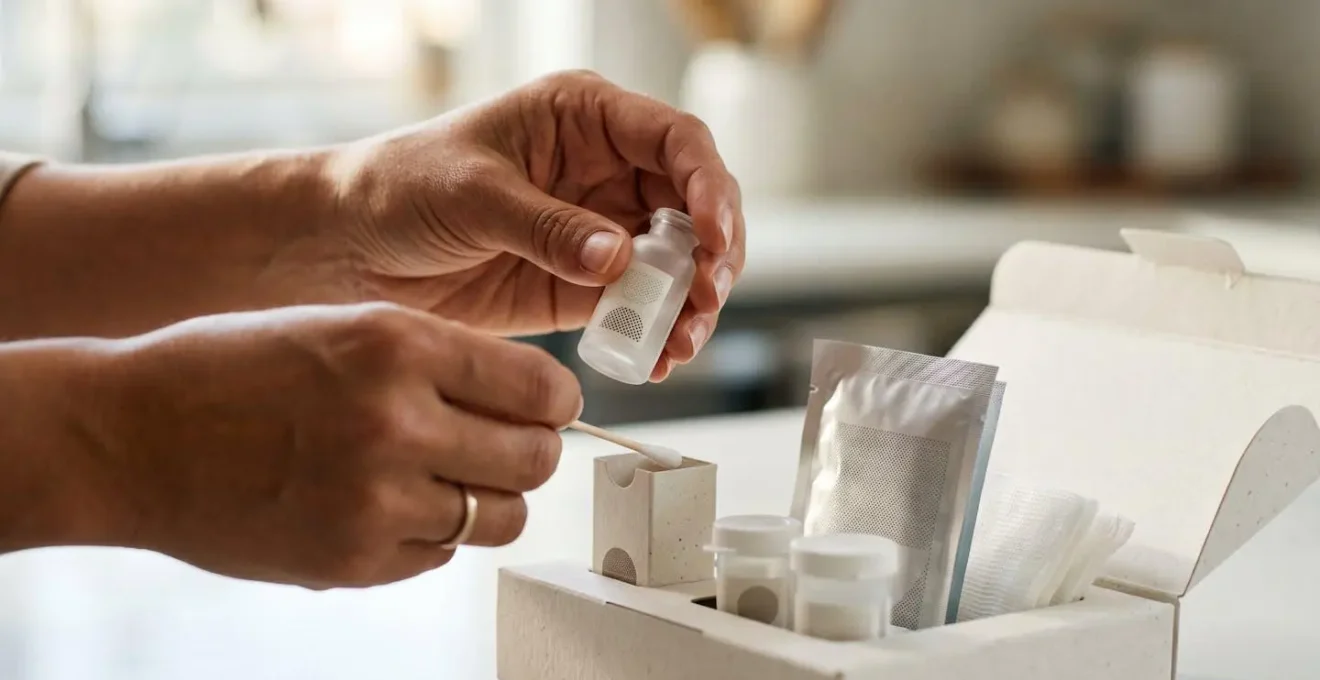
However, not all home tests are created equal. Navigating the market requires diligence to ensure the results are as accurate as those from a traditional clinic. The key is to look for services that use the same certified laboratories as healthcare providers. Choosing a reliable kit is a crucial step in taking responsible ownership of your sexual wellness.
Your Action Plan: How to Evaluate At-Home STI Test Kits
- Verify CLIA certification: Ensure the lab processing your sample is CLIA-certified (Clinical Laboratory Improvement Amendments), which means it meets federal standards for accuracy and reliability.
- Check sensitivity and specificity: Look for reported accuracy rates. According to a review of top-rated kits, many report 95% to 99% accuracy when the sample is collected correctly.
- Confirm physician review: Legitimate testing services must have a board-certified physician in your state review your results before they are released to you.
- Evaluate post-result support: The best services offer integrated medical support, often including a free consultation with a clinician if you receive a positive result, to discuss treatment options.
- Understand sample collection: Kits typically require a urine sample, a simple finger-prick blood sample, or a self-administered swab. Review the instructions to ensure you are comfortable with the process before you buy.
Single-Dose Antibiotics vs 7-Day Courses: Which Is More Effective?
Detecting an infection is only half the battle; treating it effectively is what truly breaks the chain of transmission. For uncomplicated gonorrhea, treatment guidelines have evolved specifically to combat human nature and the biology of the bacteria. The American Sexual Health Association states a clear preference in its guidelines, reflecting a major public health lesson learned over decades.
The standard recommended treatment for gonorrhea is a single injection of an antibiotic (ceftriaxone)
– American Sexual Health Association, Gonorrhea Treatment Guidelines 2025
This recommendation isn’t just about the drug’s efficacy; it’s about guaranteeing the treatment is completed. The debate between a single, observed dose and a week-long course of oral pills comes down to one critical factor: adherence. A multi-day course relies on the patient to take every single pill, on time, for the full duration—even after they start feeling better. The real-world failure rate of this approach is high, leading to undertreated infections and, most dangerously, the rise of antibiotic resistance.
The table below, based on public health data, breaks down why the single-dose strategy is overwhelmingly preferred for controlling the spread of uncomplicated gonorrhea.
| Treatment Factor | Single-Dose (Ceftriaxone Injection) | 7-Day Course (Oral Antibiotics) |
|---|---|---|
| Adherence Rate | 100% (observed administration) | Variable (patient-dependent, often incomplete) |
| Clinical Efficacy | Highly effective for uncomplicated urogenital gonorrhea | Theoretically effective, but requires full completion |
| Resistance Prevention | Reduces resistance risk through guaranteed full treatment | Incomplete courses drive antibiotic resistance |
| Best Used For | Uncomplicated urogenital and rectal infections | Pharyngeal (throat) gonorrhea and complicated cases |
| Public Health Impact | Preferred for population-level control due to adherence | Higher failure risk in real-world settings |
The Partner Notification Mistake That Leads to Ping-Pong Infection
Even with perfect testing and treatment, a crucial vulnerability remains: the untreated partner. The “Ping-Pong Effect” is a common and frustrating cycle where an individual is treated for an STI, only to be reinfected shortly after by a partner who was never notified and remains infectious. This phenomenon is a direct consequence of the silent nature of STIs combined with a breakdown in communication.
If a partner is asymptomatic, they have no reason to believe they are infected and will continue to transmit the infection. Notifying all recent sexual partners after a positive diagnosis is not an act of accusation; it is a fundamental and non-negotiable public health responsibility. The European Centre for Disease Prevention and Control (ECDC) emphasizes that some infections can be asymptomatic and transmitted further without the infected person’s knowledge, making active notification the only way to stop the cycle.
Having this conversation is understandably difficult and can evoke feelings of fear, guilt, or anxiety. However, preparing for it can make the process more manageable and effective. The goal is to deliver information calmly, factually, and without blame. Here are some communication strategies for different scenarios:
- For a new partner: “I recently tested positive for [infection name]. I wanted to let you know immediately so you can get tested and treated if needed. This is important for both our health.”
- For a long-term partner: “We need to talk about something important. I’ve tested positive for [infection name]. This doesn’t mean anyone was unfaithful—some infections can be dormant for a long time. Let’s both get treated together to ensure we’re clear.”
- For a former partner: “I’m reaching out because I recently tested positive for [infection name], and health guidelines recommend notifying recent sexual contacts. You may want to consider getting tested.”
- Use anonymous services: If direct communication is not safe or possible, use a partner notification service. Many local health departments offer programs where they will contact partners on your behalf without revealing your identity.
Should Sexually Active People Take Prophylactic Antibiotics?
The relentless rise of STIs has pushed researchers to explore new frontiers in prevention, moving beyond condoms and behavioral changes alone. One of the most talked-about and controversial strategies is the use of post-exposure prophylaxis (PEP) with an antibiotic. Known as Doxy-PEP, this involves taking a dose of doxycycline within 72 hours after sex to prevent bacterial STIs like chlamydia and syphilis.
The data on its effectiveness is compelling. A 2025 systematic review and meta-analysis found that Doxy-PEP led to a 65% reduction in chlamydia cases and a 77% reduction in syphilis cases among high-risk groups. This level of efficacy is significant and suggests a powerful new tool in our arsenal. However, the real-world impact can be slightly different from the controlled environment of a clinical trial.

While Doxy-PEP is a promising tool, it is not a magic bullet. Its primary debate centers on the risk of promoting antibiotic resistance. Widespread use of doxycycline could, in theory, lead to resistant strains of not only STIs but also other bacteria in the body. For this reason, current recommendations typically limit its use to specific high-risk populations under medical supervision. It represents a trade-off: a powerful individual prevention tool versus a potential long-term public health risk. The discussion around Doxy-PEP highlights the complex, ever-evolving nature of STI prevention, where individual risk and population health must be carefully balanced.
Why Doctors Miss Lyme Disease in 40% of Early Cases?
To understand the systemic challenge of STI control, it’s useful to look at parallels in other areas of medicine where “invisible” illnesses create Diagnostic Blind Spots. Lyme disease serves as a stark example. Despite awareness of the characteristic bullseye rash, many early infections present with non-specific, flu-like symptoms such as fatigue, fever, and body aches—symptoms that are easily dismissed or misattributed to other causes. Furthermore, the standard two-tier blood tests can produce false negatives in the first few weeks of infection before the body has mounted a measurable immune response. This combination of ambiguous symptoms and imperfect early diagnostics is why doctors can miss the disease in its most treatable stage.
The struggle for a Lyme diagnosis mirrors the experience of someone with an asymptomatic STI. In both cases, the patient’s own body does not provide a clear signal of illness, and standard medical encounters may fail to uncover the problem without a high degree of suspicion and proactive investigation. This underscores a crucial lesson: in the face of silent or ambiguous diseases, the patient must often become their own best advocate.
Empowering yourself with knowledge and documentation is key to navigating these diagnostic gray areas. Here is a toolkit for patient advocacy that can be applied to any suspected “invisible” illness:
- Symptom Journaling: Keep a detailed daily log of symptoms, including onset, duration, severity (on a 1-10 scale), and potential triggers. For skin conditions, take clear photos with good lighting.
- Requesting Specific Tests: Don’t be afraid to ask your doctor directly for specific tests you’ve researched, such as asking for both a chlamydia and gonorrhea test, or the two-tier serology test for Lyme.
- Understanding Test Limitations: Be aware of factors like seroconversion windows (the time it takes to develop antibodies). If a test is negative but symptoms persist, ask about the possibility and timing of a retest.
- Preparing for Appointments: Arrive with your symptom journal, a written list of questions, and a concise summary of your relevant history (e.g., potential exposures, travel to endemic areas).
- Seeking a Second Opinion: If your concerns are dismissed but your suspicion remains high, confidently and respectfully request a referral to a specialist, such as an infectious disease expert.
Why “1 in 5 Diabetics Don’t Know They Have It”
The phenomenon of the “undiagnosed” is not unique to infectious diseases. Type 2 diabetes provides another powerful parallel. Millions of people live with the condition for years before a formal diagnosis, largely due to a process of symptom normalization. The early signs of high blood sugar—such as increased thirst, frequent urination, and persistent fatigue—are often subtle and develop gradually. It’s easy for an individual to dismiss them as normal parts of aging, stress, or a busy lifestyle.

One doesn’t suddenly wake up with debilitating thirst; rather, they find themselves drinking slightly more water each day over months or years. The fatigue isn’t a sudden collapse but a slow, creeping drain of energy that gets written off as “just being tired.” Because there is no acute, alarming event, there is no trigger to seek medical help. This is the same insidious pattern seen with asymptomatic STIs, where the absence of a clear “problem” leads to a dangerous state of inaction.
This highlights a fundamental vulnerability in human perception and the modern healthcare model. We are conditioned to react to acute problems, not to monitor for slow, silent changes. The healthcare system, in turn, is primarily designed to treat illness that presents itself, not to proactively seek out the vast population of undiagnosed individuals. The lesson from diabetes is that for any widespread, chronic, or silent condition, a significant portion of the affected population will always be in the dark, highlighting the need for routine, population-level screening that does not depend on symptoms.
Key Takeaways
- The primary driver of rising STI rates is asymptomatic transmission, which creates a vast, hidden reservoir of infection that outpaces awareness campaigns.
- Effective personal strategy must shift from passively watching for symptoms to proactively engaging in regular testing, especially through accessible at-home options.
- Breaking the “Ping-Pong Effect” of reinfection depends on responsible and open partner communication, which is a critical public health action.
Why Diabetes Affects 30% of Your Age Group But You Didn’t Know It?
The threads connecting STIs, Lyme disease, and diabetes reveal a larger truth about modern health: our greatest challenges often lie in what we cannot see or feel. The consistent pattern of “Diagnostic Blind Spots” across different fields of medicine shows that relying on our own perception of wellness is an increasingly flawed strategy. The problem is not just one specific virus or bacteria, but a systemic issue where silent conditions thrive in the gap between infection and noticeable symptoms.
The scale of this invisible burden is staggering. Public health agencies like the CDC estimate that approximately one in five people in the United States has an STI at any given time. This is a population-level crisis that operates almost entirely beneath the surface of our daily lives. When we internalize this reality, the need for a fundamental shift in our approach to personal health becomes undeniable. It’s time to move beyond the mindset of “I’ll go to the doctor if I feel sick.”
Adopting a proactive health mindset means accepting that risk may be present even in the absence of evidence. It involves incorporating regular, routine screening into your life as a matter of course, not as a reaction to a scare. It means having open, honest, and sometimes difficult conversations with partners as a standard practice of mutual care and respect. It’s about treating your sexual health with the same seriousness and foresight as you would your financial planning or career development.
The first step in this new approach is self-assessment. Evaluate your current practices around testing and communication, and identify areas for improvement. Take the initiative to talk to your partners and your healthcare provider about creating a proactive sexual health strategy that is right for you and your circumstances.