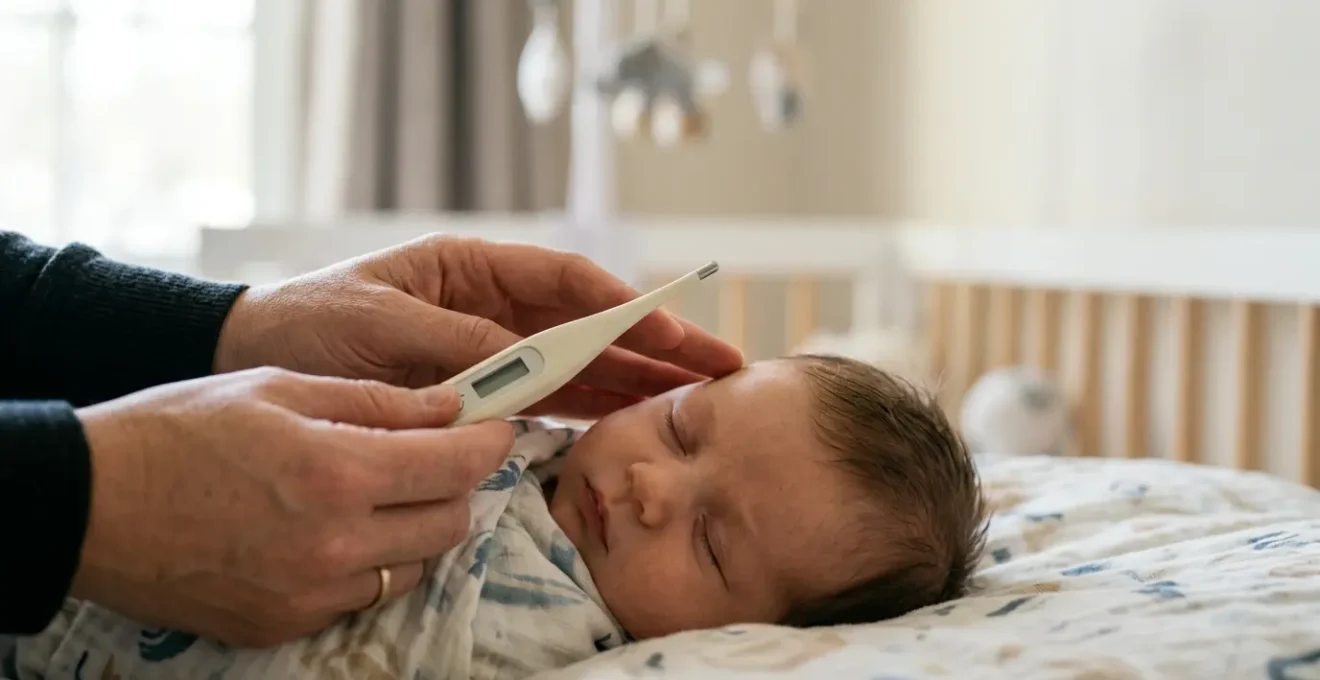
For a baby under 3 months with a temperature of 38°C or more, the decision is not *if* you should call, but *who* to call, and your observation of ‘red flag’ signs is critical.
- Call 999 immediately for life-threatening signs like unresponsiveness, difficulty breathing, a non-fading rash, or seizures.
- Call 111 for any other fever in this age group, as they will provide urgent clinical assessment and direct you to the right care, often bypassing the need for a walk-in clinic.
Recommendation: Do not give your baby paracetamol or ibuprofen before seeking medical advice, as it can mask serious symptoms and delay a crucial diagnosis.
The moment you feel that heat radiating from your baby’s forehead, your heart sinks. As a parent, especially a new one, a fever in a tiny infant feels like a siren going off in your soul. Your mind races, filled with a hundred questions, but one becomes deafeningly loud: is this a “wait and see” situation, or a genuine emergency? The internet offers a confusing mix of advice, from “it’s just a cold” to worst-case scenarios. Many articles tell you to simply “call a doctor”, which is true, but unhelpful when you’re trying to decide between calling NHS 111 for urgent advice or 999 for an ambulance at 2 AM.
I’m a paediatric nurse, and I’ve taken thousands of calls just like the one you’re thinking of making. I know the panic in your voice. My role isn’t just to follow a script; it’s to help you become my eyes and ears at home. The key isn’t just knowing the obvious symptoms, but learning to spot the subtle, pre-clinical warning signs—your baby’s “silent language”—that tell us the real story. We often hear about meningitis rashes or teething pain, but the truth is far more nuanced, especially in the first 12 weeks of life.
This guide is designed to be your at-home triage protocol. We will move beyond the platitudes and empower you to assess your baby with the structured, calm approach of a healthcare professional. We will differentiate between a normal immune response and a “red flag” that requires immediate action. By the end of this article, you will not only know *who* to call, but you’ll understand *why*, and you’ll have the confidence to act decisively and communicate effectively with medical services.
This article will provide you with a clear, structured framework to navigate this stressful situation. Below, we’ve outlined the key areas we will cover to help you make an informed and timely decision for your baby’s health.
Summary: Deciding Between 111 and 999 for Your Feverish Baby
- Why Fever in Babies Is Sometimes the Body’s Way of Fighting Infection?
- How to Spot Meningitis Early When Your Baby Can’t Speak?
- Paracetamol vs Ibuprofen: Which Is Safer for Teething Pain?
- The Rehydration Mistake That Causes Hyponatremia in Gastroenteritis
- When Can Your Child Return to Nursery After an Infection?
- Call 111 vs Walk-In: Which Gets You Seen Faster by a Doctor?
- How to Lower a Child’s Temperature Safely While Waiting for an Ambulance?
- How to Spot the Red Flag Signs of Sepsis in Children Under 5?
Why Fever in Babies Is Sometimes the Body’s Way of Fighting Infection?
First, let’s take a steadying breath. Fever, or a high temperature, is not the illness itself; it’s a symptom. In older children and adults, a fever is most often a sign that the immune system is working exactly as it should, raising the body’s core temperature to create an environment hostile to viruses and bacteria. It’s a healthy and effective defence mechanism. This is a crucial concept to grasp because it helps shift your perspective from “fever is the enemy” to “fever is a signal I need to interpret.”
However—and this is the most important rule—this logic changes dramatically for babies under 3 months old. A newborn’s immune system is still immature and underdeveloped. They haven’t been exposed to many germs and their ability to fight off serious infection is limited. For this reason, any fever in a baby under 3 months is treated as a potential medical emergency until proven otherwise. A temperature of 38°C or higher is the universally accepted threshold that requires an immediate medical assessment.
Think of it this way: in an older child, a fever is like a fire alarm for a small, contained kitchen fire. In a newborn, it’s a fire alarm where you can’t be sure if it’s a piece of toast or the whole house on fire. Because of this uncertainty, we must always assume the latter and call for help. Your job as a parent isn’t to diagnose the cause, but to recognise the signal and act on it swiftly. This isn’t about causing panic, but about applying a critical layer of safety for the most vulnerable.
How to Spot Meningitis Early When Your Baby Can’t Speak?
When parents hear “fever” and “baby,” their minds often jump to meningitis, and for good reason. It’s a rare but extremely serious condition. The classic signs you may have heard of, like a stiff neck, a dislike of bright lights, and the non-blanching rash (a rash that doesn’t fade when you press a glass against it), are often late-stage symptoms. Waiting for these is not an option. You need to learn your baby’s silent language and spot the earlier, more subtle behavioural changes.
One of the most important things to monitor is your baby’s overall appearance and behaviour. Do they seem “not themselves”? This parental instinct is a powerful clinical tool. Look for a vacant stare or glazed eyes, unusual stillness or floppiness (lethargy), or a change in their cry. A high-pitched, moaning, or unusually weak cry is a significant red flag. Another key indicator can be cold hands and feet despite having a fever. This suggests the body is diverting blood to the core organs, a potential sign of shock or sepsis. As the experts at Meningitis Now state, you must act on these observations before it’s too late.
Do not wait for a rash. If someone is ill and getting worse, get medical help immediately. The rash associated with meningitis is actually caused by septicaemia. You should never wait for a rash, it can be a late sign or may not appear at all.
– Meningitis Now, Signs and Symptoms in Babies and Toddlers
Trust what you see. A baby who is difficult to wake, refuses to be comforted in ways that normally work, or who seems abnormally quiet and still, is sending a powerful distress signal. These behavioural signs are often the very first clues that a serious infection like meningitis could be developing.
Paracetamol vs Ibuprofen: Which Is Safer for Teething Pain?
It’s a natural instinct: your baby is in pain or has a fever, and you want to make them comfortable. Reaching for a bottle of infant pain reliever seems like the logical first step. However, when dealing with a baby under 3 months, this instinct can be dangerous. The primary rule is: never give medication for a fever to a baby under 3 months without direct medical advice. Giving paracetamol (like Calpol) or ibuprofen can lower their temperature and mask the severity of their symptoms, making it much harder for a doctor or paramedic to accurately assess how sick they truly are. It can delay a crucial diagnosis.
For general teething or minor discomfort in babies over 3 months, both paracetamol and ibuprofen are considered safe when used correctly. Paracetamol can generally be given from 2 months for conditions other than fever (post-vaccination, for example) but always check with a pharmacist or doctor. Ibuprofen has a stricter age limit, typically licensed for babies aged 3 months and over who also weigh more than 5kg. As the guidance from Sheffield Children’s NHS Foundation Trust clarifies, these rules are not interchangeable.
| Medication | Minimum Age | Dosing Frequency | Maximum Doses/24h | Key Safety Notes |
|---|---|---|---|---|
| Paracetamol | 2 months (with medical advice) 3 months (over the counter) |
Every 4-6 hours | 4 doses | Should NOT be given to babies under 2 months without doctor’s prescription. Safe for most babies when dosed correctly. |
| Ibuprofen | 3 months AND over 5kg weight | Every 6-8 hours | 3 doses | NOT licensed for children under 3 months or weighing less than 5kg. Should not be used in babies with kidney conditions, asthma, or dehydration. |
| Critical Warning for Babies Under 3 Months with Fever | ||||
| Medical advice is MANDATORY before giving ANY medication to a baby under 3 months with fever. Do NOT give fever reducers before medical assessment as it can mask the severity of underlying illness and delay crucial diagnosis. | ||||
The key takeaway is that these medications are not for treating an undiagnosed fever in a very young infant. Their purpose is to provide comfort once a serious illness has been ruled out by a professional, or for managing predictable discomforts like teething or post-immunisation symptoms in the appropriate age group. For a feverish baby under 3 months, your first action is the phone, not the medicine cabinet.
The Rehydration Mistake That Causes Hyponatremia in Gastroenteritis
When a baby has diarrhoea or is vomiting, dehydration is a primary concern. The natural instinct for many parents is to offer water. This is a critical and potentially dangerous mistake. Giving large amounts of plain water to an infant with gastroenteritis can lead to a condition called hyponatremia, or water intoxication. This occurs when the body’s sodium levels become dangerously diluted, which can cause cells to swell, leading to severe neurological problems, including seizures. It is a medical emergency.
The correct approach is to use a specially formulated Oral Rehydration Solution (ORS), which you can buy from any pharmacy. These solutions contain the perfect balance of water, salts, and sugars needed to rehydrate your baby safely. You must use the “little and often” method, especially if your baby is vomiting. This involves giving a very small amount (around 5ml from a syringe or spoon) every few minutes. This prevents overloading their stomach and gives the fluid a chance to be absorbed. If your baby is breastfed, continue to offer the breast as breast milk is an excellent fluid for rehydration.
It’s also vital to distinguish the signs of dehydration from the red flags of hyponatremia, as they can appear similar to a panicked parent. The table below helps clarify the key differences. A sunken soft spot (fontanelle) and no tears are classic signs of dehydration, while unusual lethargy or seizures in a baby who otherwise seems ‘puffy’ or not visibly dehydrated could point towards hyponatremia. In either case, medical advice is essential.
Your action plan: How to Administer Oral Rehydration Solution (ORS) to Vomiting Babies
- Use the ‘little and often’ syringe method: Give 5ml of ORS every 5 minutes using an oral syringe or small spoon.
- For mild dehydration: Administer 50-60ml/kg of ORS over 4 hours.
- For moderate dehydration: Administer 80-100ml/kg of ORS over 4 hours.
- If baby vomits: Wait 10 minutes, then restart with smaller amounts (2.5ml every 2-3 minutes).
- Gradually increase volume if baby tolerates: If successfully keeping fluids down, slowly increase the amount given per dose.
- Continue breastfeeding: If breastfed, offer breast milk alongside ORS – breast milk is the best fluid for breastfed babies.
When Can Your Child Return to Nursery After an Infection?
After the stress and worry of a feverish illness, a question eventually arises: when is it safe for my child to go back to their nursery or childcare setting? This is important not just for your child’s well-being but also to prevent the spread of infection to other children. The guidance from health authorities is generally clear and consistent, focusing on the absence of fever as a key milestone.
The most common rule of thumb, widely adopted by nurseries and public health bodies, is the 24-hour fever-free rule. This means your child’s temperature must have returned to normal (typically below 37.5°C) and remained normal for a full 24 hours without the use of fever-reducing medications like paracetamol or ibuprofen. This last part is critical; if you are still giving Calpol to keep their temperature down, they are not ready to return.
This rule ensures that the child is genuinely over the infectious period of their illness. As Children’s Hospital Colorado advises, this is a clear benchmark for recovery. Some specific illnesses, like chickenpox or hand, foot, and mouth disease, may have additional exclusion periods based on the state of the rash or sores, and you should always follow your nursery’s specific policy. But for most common viral illnesses that cause fever, the 24-hour rule is the gold standard.
Your child can return to child care after the fever is gone for 24 hours.
– Children’s Hospital Colorado, Fever (0-12 Months) Guidance
Thinking about this “after” stage can be a comforting thought during the peak of the illness. It represents a return to normality. However, always prioritise the health of your child and their community by adhering strictly to these guidelines. Rushing back too soon can risk a relapse for your child and an outbreak at the nursery.
Call 111 vs Walk-In: Which Gets You Seen Faster by a Doctor?
In a moment of panic with a sick baby, your instinct might be to bundle them up and rush to the nearest A&E or walk-in centre. This can often be the wrong choice. For a baby under 3 months with a fever, your first call should always be 111 (unless they are showing clear 999 symptoms like unresponsiveness or difficulty breathing). Calling 111 is not a delay; it is an access point to a streamlined urgent care pathway.
When you call 111, you are initiating a clinical triage process. A trained health advisor or clinician will assess the situation over the phone. For a feverish baby under 3 months, this automatically triggers a high-priority pathway. Instead of sitting for hours in a crowded waiting room with other sick people, 111 can often book you a direct, timed appointment at an Urgent Treatment Centre, a children’s assessment unit, or advise you to go directly to A&E. This “talk before you walk” approach ensures you are directed to the right place, first time, where the right specialists are expecting you.
This process is far more efficient and safer for your baby than simply showing up unannounced. It reserves A&E for true, life-threatening emergencies and ensures your baby gets the appropriate level of care as quickly as possible. Understanding what happens during the call can reduce anxiety, so you can provide clear, calm information to the call handler.
Your checklist: What Happens During Your NHS 111 Call for a Sick Baby
- Initial contact: You’ll first speak to a trained call handler who will ask basic information about your baby’s symptoms.
- Clinical triage: A nurse or paramedic will then assess your baby’s condition by asking specific clinical questions about temperature, breathing, feeding, and behavior.
- Symptom assessment: They’ll use a structured checklist to identify ‘red flag’ symptoms that require urgent attention.
- Outcome determination: Based on the assessment, they’ll provide one of several outcomes: self-care advice, GP appointment (same-day or routine), Urgent Treatment Centre appointment with specific time slot, or dispatch of an emergency ambulance.
- Direct referral pathway: If your baby under 3 months has fever >38°C, you’ll likely be advised to attend A&E or a same-day emergency pediatric assessment.
- Safety netting: You’ll receive clear advice on what symptoms to watch for and when to call back if your baby’s condition changes.
How to Lower a Child’s Temperature Safely While Waiting for an Ambulance?
You’ve made the call. Help is on the way. The time between calling 999 and the paramedics arriving can feel like an eternity, and your instinct is to do *something*. This is where the concept of “productive waiting” comes in. Your goal is not to try and cure your baby, but to keep them safe and comfortable, and to prepare for the arrival of the medical team. First, let’s dispel a dangerous myth. You should never sponge your baby with cool water. This practice is no longer recommended and can be harmful.
Tepid sponging is no longer recommended for the treatment of fever. It doesn’t reduce your child’s temperature and may cause your child to shiver.
– North Tees and Hartlepool NHS Foundation Trust, How to Recognise if Your Child is Seriously Ill
Shivering is the body’s way of generating heat, so tepid sponging can actually cause their internal temperature to rise. Instead, focus on simple, safe measures. Remove any excess layers of clothing or blankets, but do not leave them naked or under-dressed. A single layer like a vest or sleepsuit is usually appropriate. You can also offer small, frequent sips of their usual milk if they are awake, alert, and not vomiting.
Beyond comfort, your most valuable role now is to become an information gatherer. The paramedics will need a clear history of events. Use this waiting time to get everything ready. This transforms your anxiety into focused, helpful action that will save precious time when help arrives.
Your action plan: Productive Waiting Checklist While Awaiting Emergency Help
- Document timeline: Write down when symptoms started, all temperature readings with times, and any changes in baby’s condition.
- Gather medications: Collect all medications your baby takes (even vitamins) and have them ready to show paramedics.
- Locate Red Book: Find your baby’s Personal Child Health Record (Red Book) which contains vital medical history and vaccination records.
- Prepare access: Unlock your front door or arrange for someone to meet the ambulance to ensure no delay in paramedics reaching your baby.
- Keep baby comfortable: Remove excess layers (dress baby normally, not overdressed), offer small frequent drinks if baby is alert and not vomiting.
- Prepare to travel: Pack a bag with nappies, formula (if bottle-fed), and a change of clothes in case you need to go to hospital.
- Monitor continuously: Keep checking baby’s breathing, skin color, and responsiveness, and note any changes to report to paramedics.
Key takeaways
- For any baby under 3 months with a temperature of 38°C or higher, medical assessment is not optional, it is mandatory.
- Trust your parental instinct. A baby who is “not themselves”—lethargic, with a different cry, or refusing to feed—is sending a clear distress signal that needs to be heeded.
- Never give fever-reducing medication before a medical assessment, and never use tepid sponging. Your role is to observe and report, not to mask the signs of a potentially serious illness.
How to Spot the Red Flag Signs of Sepsis in Children Under 5?
Throughout this guide, our focus has been on one critical goal: identifying a seriously unwell child. Sepsis, sometimes called septicaemia or blood poisoning, is the body’s extreme reaction to an infection and is a life-threatening medical emergency. It can be triggered by any infection, including meningitis. The statistics are sobering; around 1 in 6 people who get bacterial meningitis die, and many more are left with severe complications, which is why early recognition of sepsis is paramount.
For babies, especially those under 3 months, the signs can be vague and easy to miss if you don’t know what to look for. One of the most crucial points is that a low temperature (under 36°C) can be just as alarming as a high one. This is a sign the baby’s body is failing to cope with the infection. Other “red flag” signs to look for include breathing difficulties (breathing very fast, grunting, or seeing the muscles under the ribs being sucked in with each breath), changes in skin colour (mottled, bluish, or very pale), and extreme lethargy or floppiness.
A baby who is not feeding, is difficult to wake, seems vacant, or has a cry that is either inconsolable or abnormally silent is a baby in trouble. These are not signs to “wait and see.” These are signs that warrant an immediate 999 call. Your prompt action, based on these observations, is the single most important factor in securing a positive outcome for your child.
Your checklist: Sepsis Recognition in Newborns: Unique Warning Signs Under 3 Months
- Low temperature alert: A temperature UNDER 36°C (hypothermia) is as much a red flag as high fever in babies under 3 months.
- Abnormal temperature range: Temperature more than 38°C OR under 36°C (unless within 48 hours of vaccinations with no other red features).
- Breathing difficulty: Breathing very fast, too breathless to feed, grunting noises, or muscles drawing in below ribs.
- Skin color changes: Mottled, bluish, ashen, or very pale skin – check palms, soles, lips and tongue especially on darker skin tones.
- Extreme lethargy: Baby is floppy, difficult to wake, not responding normally, or appears vacant and unaware.
- Feeding refusal: Baby under 1 year not feeding or taking less than half usual milk amount.
- Inconsolable crying or unusual silence: Either extremely irritable and impossible to comfort, or abnormally quiet and still.
Now that you are equipped with this knowledge, your next step is to trust your judgement. If you are ever in doubt, always make the call. It is always better to have called for help and for it to be a false alarm than to wait and wish you had called sooner.