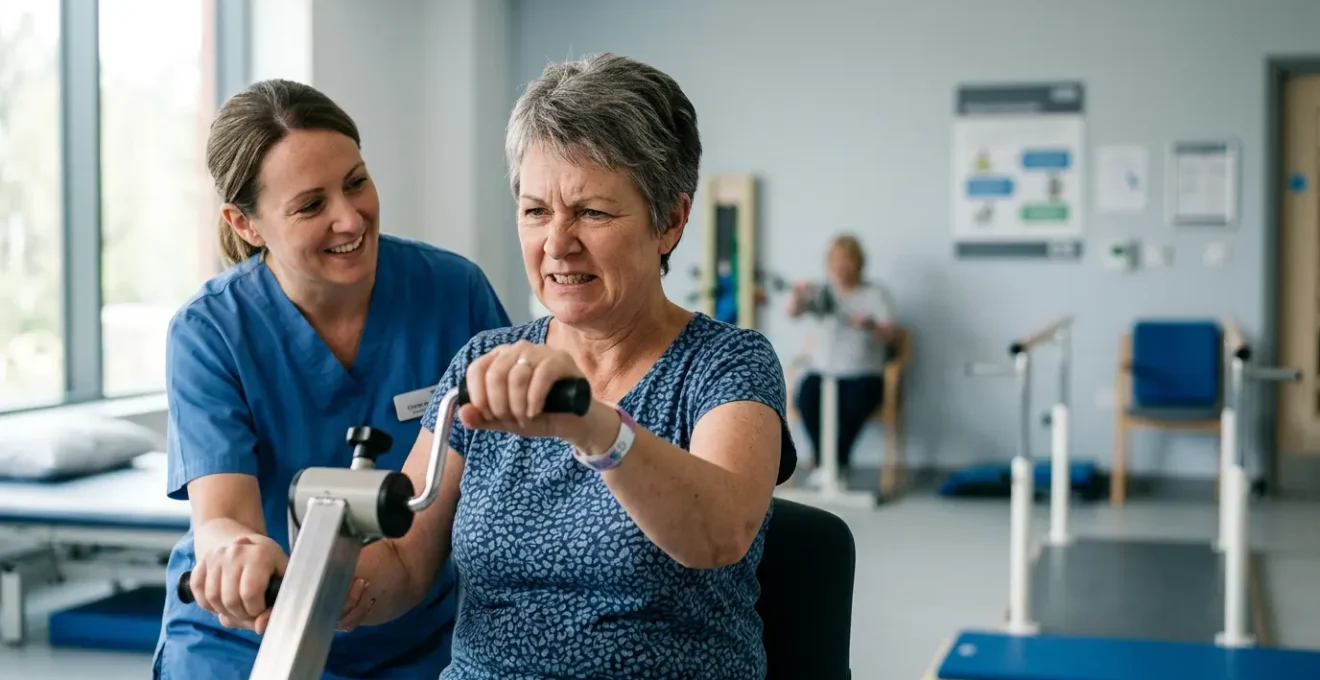
The critical mistake in stroke recovery is passively waiting for NHS physiotherapy; the solution is to strategically build your own high-intensity rehab program around it.
- The NHS provides a vital foundation, but its limited session time is insufficient for optimal neuroplastic change.
- Your home environment and daily routines must be actively redesigned to create a constant state of rehabilitation.
Recommendation: Use the time between NHS appointments for targeted, high-repetition exercises, turning waiting periods into your most productive recovery phase.
The day of discharge from the hospital after a stroke is a mix of relief and anxiety. The structured environment of the ward, the daily check-ins, and the scheduled physiotherapy sessions are replaced by the familiar quiet of your own home. For many patients and their families, a daunting question soon arises: “Is this it?” You’ve been given a sheet of exercises and a promise of a follow-up, but there’s a growing awareness that the brief, infrequent sessions offered by community NHS services may not be enough to get you back to where you want to be.
As a neuro-physiotherapist, I see this scenario play out daily. The NHS does incredible work under immense pressure, providing an essential safety net and initial rehabilitation. However, the system is designed for broad-stroke intervention, not personalised, intensive, long-term recovery. The advice to “stay positive” and “do your exercises” is well-meaning but overlooks a fundamental truth: optimal recovery isn’t about passively receiving therapy. It’s about actively building a comprehensive rehabilitation architecture for your life.
But what if the very limitations of the system are not a barrier, but an opportunity? What if the true key to unlocking your potential isn’t about getting *more* NHS therapy, but about becoming the architect of your own recovery, using the NHS as a starting pistol, not the entire race? This isn’t about criticising the system, but empowering you to work with it, and crucially, beyond it.
This guide provides a strategic roadmap to do just that. We will explore why the first few months are a non-negotiable window of opportunity, how to turn your home into an effective rehab gym on a budget, and how to navigate the emotional and practical hurdles that can stall progress. This is your plan for taking control and accelerating your journey back to independence.
To navigate this comprehensive guide, the summary below outlines the key strategic areas we will cover. Each section is designed to provide actionable insights and practical steps, empowering you to bridge the gaps in standard care and maximise your recovery potential.
Summary: A Neuro-Physio’s Strategic Guide to Stroke Recovery
- Why the First 3 Months Are Critical for Regaining Movement?
- How to Set Up a Home Rehab Gym for Under £100?
- NHS vs Private Rehab: Is More Therapy Always Better?
- The Emotional Mistake That Stalls Physical Recovery Progress
- When Can You Legally Drive Again After a Stroke?
- How to Access Physiotherapy Without Seeing a GP First?
- How to Prepare Your House for Recovery Before You Go to Hospital?
- Managing the Wait: How to Stay Proactive Between NHS Physio Sessions
Why the First 3 Months Are Critical for Regaining Movement?
Following a stroke, the brain enters a state of heightened neuroplasticity—its ability to reorganise itself by forming new neural connections. This period doesn’t last forever. There is a “critical window” for motor recovery, a time of peak opportunity to reclaim movement. Missing this window doesn’t mean recovery stops, but it does mean the process becomes significantly slower and more challenging. The brain is most receptive to intensive, repetitive, and task-specific training in the immediate aftermath of the injury.
Scientific evidence strongly supports this urgency. A landmark randomised controlled trial confirmed that the window from 60 to 90 days post-stroke shows the optimal sensitive period for intensive motor rehabilitation. This is the time to apply what we call “Neuroplastic Dosing”—providing the brain with the right frequency, intensity, and duration of exercises to force it to rewire. Waiting for a weekly 30-minute physio slot to begin in a month’s time means you are losing the most valuable currency you have: time in the critical window.
The goal is to combat “learned non-use,” a phenomenon where the brain effectively gives up on trying to use the affected limb, making recovery harder. Action must start from day one. This involves not just performing isolated exercises, but integrating the affected side into bilateral activities, focusing on high-repetition movements, and establishing a consistent daily schedule. This isn’t just about muscle strength; it’s about speaking the language of the brain to convince it to heal.
How to Set Up a Home Rehab Gym for Under £100?
The idea of a “home gym” might conjure images of expensive, bulky equipment, but for stroke rehabilitation, the most effective tools are often the simplest and cheapest. Creating your own “Rehab Architecture” doesn’t require a large budget; it requires a strategic selection of items that facilitate high-repetition, task-specific practice. Your goal is to create a dedicated space that removes barriers to daily exercise and makes consistency effortless. For under £100, you can assemble a powerful toolkit.
Your core investment should focus on versatility and function. A height-adjustable bedside table (£25-40) is invaluable for supporting your arm at the correct height during seated exercises. Therapy putty and hand therapy balls (£15-25 total) are non-negotiable for improving grip strength and fine motor skills. They are portable, allowing for high-repetition practice while watching television or resting. This frequent, low-intensity stimulation is crucial for neuroplastic change.
This setup shows how simple tools can create a powerful feedback loop for the brain. The visual input from the mirror is often one of the most effective ways to overcome the feeling of a disconnected or paralysed limb, tricking the brain into rebuilding those neural pathways.
Perhaps the most cost-effective and powerful tool is a large tabletop mirror (£15-25) for mirror therapy. By reflecting the movement of the unaffected limb, you can “trick” your brain into perceiving movement in the affected limb, stimulating motor pathways. Finally, a simple step stool with a handle (£20-30) can be used for a variety of balance and mobility drills. These few items, combined with free smartphone apps for metronomes or video recording, create a rehabilitation station that is arguably more effective than a complex multi-gym because it targets the specific needs of stroke recovery.
NHS vs Private Rehab: Is More Therapy Always Better?
When faced with the reality of limited NHS sessions, the immediate impulse is to seek out private physiotherapy. The question then becomes: is more therapy always better? The answer is nuanced. It’s not about the sheer quantity of therapy but its quality, timing, and integration into your overall plan. The fundamental issue with NHS provision is one of dosage. Data from the UK shows that stroke patients receive just 32 minutes of physiotherapy on average on just over half of their days in hospital, a dose far too low to drive significant neuroplastic change for many.
This is where the concept of “System Bridging” becomes essential. Instead of viewing NHS and private therapy as an either/or choice, the strategic approach is to use private sessions to fill the specific gaps left by the NHS. A private physio can provide a thorough assessment, create a more advanced and personalised home exercise program, and teach you and your family how to execute it safely. You might only need a few targeted private sessions to “level up” the program you can then perform independently for hundreds of hours at home.
The following table breaks down the key differences, highlighting why a blended approach is often the most effective strategy for long-term recovery.
| Aspect | NHS Physiotherapy | Private Physiotherapy |
|---|---|---|
| Cost | Free at point of service | Pay per session (variable pricing) |
| Waiting Time | May be long waiting list | Immediate or short wait |
| Session Frequency | Target: 45 min/day, 5 days/week (not always met) | Flexible, can be more intensive |
| Specialization Access | Standard rehab approaches | Specialized techniques (CIMT, robotics, hydrotherapy) |
| Treatment Duration | Focused on initial 3-6 months post-stroke | Long-term support available if funded |
| Required Qualifications | HCPC registered physiotherapists | Check for HCPC, MCSP, MACPIN, SRP credentials |
| Coordination | Integrated with stroke unit multidisciplinary team | Must coordinate separately with NHS team |
The goal is not to replace the NHS, but to augment it. Use private therapy for strategic interventions: to overcome a plateau, to learn a new complex skill, or for an intensive block of therapy like constraint-induced movement therapy (CIMT) that isn’t widely available on the NHS. More therapy isn’t always better; *smarter* therapy is.
The Emotional Mistake That Stalls Physical Recovery Progress
In my years as a neuro-physiotherapist, I’ve observed that the biggest threat to a patient’s recovery is rarely physical. It’s the emotional mistake of setting the wrong expectations. After a stroke, progress is not linear. There will be good days and bad days, bursts of improvement followed by frustrating plateaus. The most common mistake is to pin all hope on large, distant milestones—like walking unaided or returning to work—while ignoring the small victories along the way.
This focus on the end goal creates a dangerous psychological trap. When progress inevitably slows, it’s easy to become disheartened, to feel like a failure, and to think, “What’s the point?” This leads to reduced effort, missed exercise sessions, and the very “learned non-use” we fight so hard to prevent. The stall in physical progress is almost always preceded by a dip in motivation and emotional resilience. This is the recovery plateau myth: the plateau feels like an endpoint, but it’s actually a signal that your brain needs a new challenge or that your spirit needs encouragement.
The antidote is to consciously celebrate small wins. Did you manage to open a jar today that you couldn’t last week? That’s a victory. Did you stand for 30 seconds longer without support? That’s a huge achievement. These small steps are the building blocks of the larger milestones.
Tracking these small gains in a journal can be incredibly powerful. It provides concrete evidence of progress when it feels like you’re standing still. Recovery is a marathon, not a sprint. The emotional journey is as important as the physical one. By shifting your focus from the mountain top to the path immediately in front of you, you build the resilience needed to keep climbing, one small, victorious step at a time.
When Can You Legally Drive Again After a Stroke?
Regaining the ability to drive is a significant milestone for independence after a stroke. However, it is governed by strict rules for your safety and the safety of others. The Driver and Vehicle Licensing Agency (DVLA) has a clear, mandatory process that cannot be bypassed. Understanding these legal requirements from the outset is crucial to managing expectations and planning your return to the road safely and legally. It’s not a matter of personal judgment; it is a matter of law.
The initial restriction is absolute: you must not drive for at least one month after your stroke or TIA (transient ischaemic attack). This applies to all car and motorcycle drivers. For Group 2 licence holders (bus and lorry drivers), the restriction is at least one year. After this initial period, your ability to return to driving depends entirely on the nature of the lasting effects of your stroke. You are legally obligated to notify the DVLA if you have any residual problems that could affect your ability to drive safely.
Your Action Plan: Navigating the DVLA Process Post-Stroke
- Observe the Mandatory Ban & Inform Insurance: You must not drive for at least one month. Crucially, you must inform your car insurance company about your stroke immediately, as failure to do so could invalidate your policy, even if you are medically cleared to drive.
- Self-Assess Against DVLA Criteria: After one month, you must check if any ongoing issues require you to notify the DVLA. These include weakness in limbs, vision problems, seizures, or cognitive issues with memory and concentration.
- Submit Official DVLA Notification: If you have any of the specified medical conditions, you must formally notify the DVLA using the STR1V form or their online service. Failing to do so is a criminal offence and can result in a fine of up to £1,000.
- Cooperate with the DVLA Assessment: The DVLA will review your case. They may make a decision based on the information provided, contact your doctor, or require you to undergo a medical examination or an official driving assessment to determine your fitness to drive.
- Consider a Professional Driving Assessment: Before getting back on the road, it is highly advisable to contact a local Driving Mobility centre. They can provide an expert, independent assessment of your abilities and recommend any necessary vehicle adaptations.
Navigating this process can be frustrating, but it is a non-negotiable part of a safe recovery. Your GP cannot clear you to drive; only the DVLA can make that legal determination. Patience and thoroughness are key.
How to Access Physiotherapy Without Seeing a GP First?
One of the most frustrating parts of the recovery journey can be waiting. Waiting for a GP appointment, only to be told you need to wait again for a referral to the community physiotherapy service. However, in many parts of the UK, it is now possible to bypass this first step and refer yourself directly to NHS physiotherapy services. This is a crucial piece of knowledge for anyone wanting to take a proactive stance on their recovery—a core tenet of “Active Waiting”.
Self-referral empowers you to get into the system faster. The process typically involves completing a form found on your local NHS trust’s website or by asking at your GP surgery reception. The key to a successful self-referral is how you frame your needs. Physiotherapy services are commissioned to improve function and independence. Therefore, when completing the form, you must describe your limitations not in medical terms, but in the language of daily life.
Instead of saying “I have left-sided weakness,” describe the functional impact: “I am unable to dress my upper body independently,” “I cannot prepare a simple meal safely due to poor balance and a weak grip,” or “I am at high risk of falling when using the stairs.” This “Activities of Daily Living” (ADL) language directly aligns with the assessment criteria of physiotherapists and occupational therapists, highlighting your clinical need in a way they can act upon. Prepare a one-page summary of your discharge notes, current limitations (in ADL terms), and your personal recovery goals to have on hand.
How to Prepare Your House for Recovery Before You Go to Hospital?
The transition from hospital to home is one of the most critical moments in stroke recovery. A home that is not prepared for your new needs can be not only frustrating but dangerous, increasing the risk of falls and hindering rehabilitation. With 60% of stroke survivors leaving hospital with a disability, preparing the environment for a safe return is not an afterthought—it’s a priority. This is the foundation of your home “Rehab Architecture”, and it should ideally be planned before you are even discharged.
The most important action you or your family can take is to request a pre-discharge home visit from an NHS Occupational Therapist (OT). An OT is an expert in assessing the home environment and recommending modifications and equipment to maximise safety and independence. They can help you source essential aids like grab rails for the bathroom, non-slip mats, shower seats, and raised toilet seats, many of which can be provided by or sourced through local council services.
Beyond safety, you can strategically adapt the environment to promote recovery. This involves a concept of “forced use”. For example, consciously place frequently used items like the TV remote, your phone, or a glass of water on your affected side. This creates dozens of natural, low-stakes opportunities throughout the day to practice reaching and using your weaker arm. It turns your living room into a therapy space. If your home has stairs, consider temporarily converting a ground-floor room into your main living and sleeping area. This conserves precious energy that can be better spent on targeted rehabilitation exercises rather than simply getting up and down stairs.
Key Takeaways
- The First 90 Days are Golden: The brain’s ability to rewire is at its peak; intensive, daily practice during this window is non-negotiable for maximising motor recovery.
- Build Your Own Rehab: The limitations of NHS physio require a proactive approach. You must become the architect of your own recovery by creating a structured, high-repetition home program.
- Strategy Over Volume: More therapy isn’t always better. Use private physio strategically to bridge gaps and get expert guidance, not just to replace the NHS. Progress comes from smarter, not just harder, work.
Managing the Wait: How to Stay Proactive Between NHS Physio Sessions
You’ve been discharged, you’ve set up your home, and you’re on the waiting list for community physiotherapy. This period of “active waiting” is where many recoveries either flourish or falter. Viewing this time as a passive delay is a mistake. This is your opportunity to consolidate the gains made in hospital and build a solid foundation for the next phase of your rehabilitation. The work you do now, on your own, is what will truly define the trajectory of your recovery.
The first rule is simple: do not stop. You must diligently continue with the exercise program you were given upon discharge. These exercises are designed to prevent regression and maintain your current level of function. Secondly, if you are offered an Early Supported Discharge (ESD) service, seize it. This service aims to provide a hospital-level intensity of therapy in your home for up to six weeks and can be a powerful bridge. If not, this is the perfect time for a strategic, one-off private physiotherapy session to get a more advanced program to work on while you wait.
Stay on the radar of the community rehab team. A polite phone call every couple of weeks to inquire about your position on the list and ask about any cancellations shows you are engaged and motivated. Keep a simple diary of your functional difficulties. This creates a clear record of your ongoing clinical need that will be invaluable when you finally get your first appointment. You are not just a patient; you are the manager of your own recovery project.
Your journey is unique, but the principles of proactive, intensive, and strategic rehabilitation are universal. By taking ownership of your recovery and implementing these strategies, you move from being a passive recipient of care to the active driver of your own progress. Start today by choosing one action from this guide and putting it into practice.