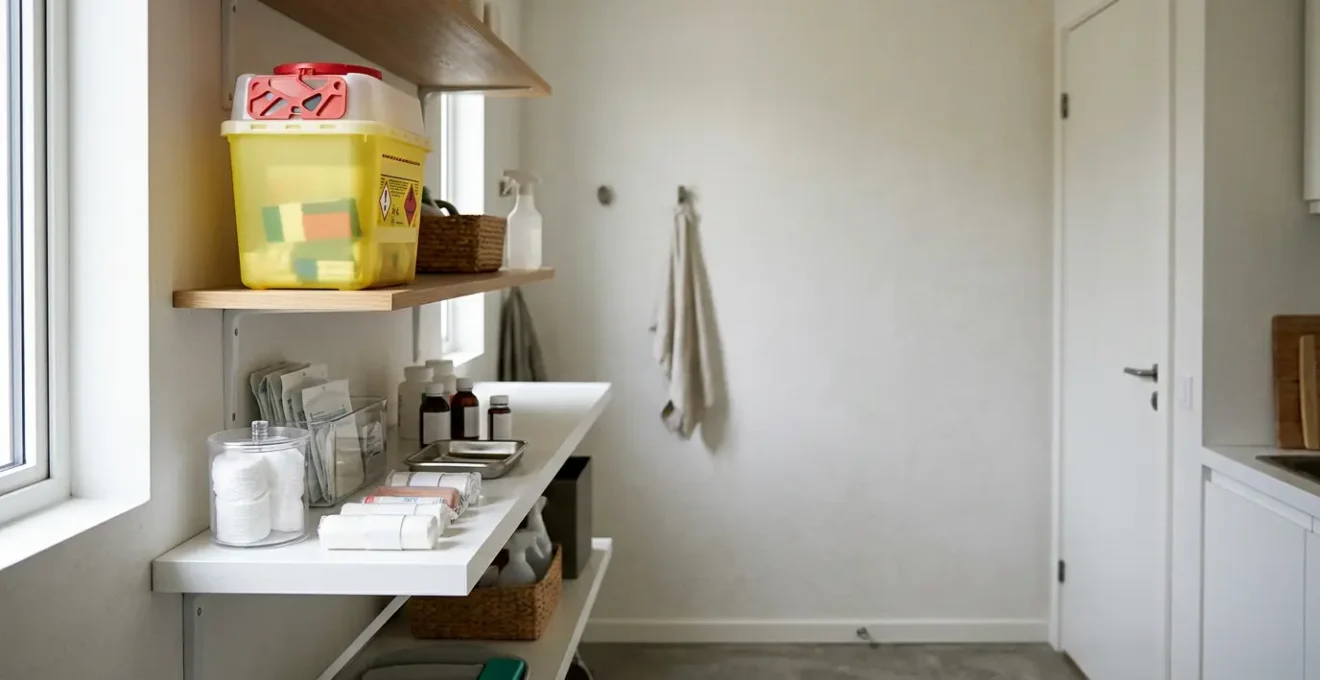
Proper sharps disposal is not an afterthought; it is a critical, legally-mandated part of your personal risk management protocol.
- Ignoring correct procedures exposes you to significant financial penalties and civil liability.
- Your local council is your primary resource for arranging a compliant clinical waste collection.
- Using the wrong colour-coded bin or unsafe handling practices creates immediate physical danger.
Recommendation: The first and most crucial step is to contact your local council to understand their specific clinical waste collection service and registration process.
For anyone managing a health condition like diabetes or undergoing injectable treatments at home, the routine can become second nature. The injection, the test, the relief. But what happens in the second after the needle is used? For many, this is where a clear process gives way to uncertainty and risk. The temptation to drop a used lancet into the general waste is a common but dangerous mistake, born from a lack of clear, accessible information. Standard advice often stops at “use a sharps bin,” leaving a host of critical questions unanswered.
The reality is that household clinical waste is governed by strict environmental and public health laws. The common platitudes—”be careful,” “keep it safe”—are insufficient. They fail to address the specific legal liabilities, the operational steps for arranging a collection, or the subtle but critical differences in equipment that ensure safety. This guide moves beyond the basics. We will not just tell you what to do; we will explain the legal and safety rationale behind each step, framing waste management not as a chore, but as a professional-grade personal risk protocol.
The core principle is this: managing your health responsibly includes managing the waste it generates. This is about protecting yourself from injury, your family from accidental exposure, and your community from environmental hazards. It also shields you from significant financial penalties. This article will provide a complete, step-by-step framework to handle your sharps and medical waste with the same precision and care as your treatment itself. We will cover the legal stakes, the practical logistics of council collections, the critical safety procedures, and how this protocol fits into the larger picture of your long-term health management.
This guide provides a comprehensive overview of the procedures and regulations for handling medical waste at home. The following sections will detail every aspect of creating a safe and compliant disposal system.
Summary: A Guide to Home Medical Waste Disposal
- Why throwing needles in general waste fines you up to £5,000?
- How to arrange a clinical waste collection with your local council?
- Yellow vs orange bins: which one is for cytotoxic waste?
- The recapping mistake that causes 80% of needlestick injuries
- Where to store your sharps box to keep children safe?
- How to spot poor hygiene protocols in a care home visit?
- The foot care mistake that leads to amputation in diabetics
- Managing type 2 diabetes without medication: is it possible?
Why throwing needles in general waste fines you up to £5,000?
The disposal of sharps is not a matter of personal preference; it is a subject of UK law. Tossing a used needle or lancet into your household rubbish is classified as producing, keeping or disposing of controlled waste in a manner likely to cause pollution of the environment or harm to human health. Under the Environmental Protection Act 1990, this is a serious offence. The consequences are not trivial; they are designed to be a powerful deterrent. Individuals can face fines of up to £5,000 and a criminal record. This is not a theoretical risk; local authorities are empowered to prosecute.
The financial liability extends beyond statutory fines. If a sanitation worker sustains a needlestick injury from your improperly disposed of sharp, you could be subject to a civil lawsuit for damages. The cost of compliance, by contrast, is minimal. Many councils offer a free collection service for clinical waste. Where a fee is charged, it is typically a small annual sum (£30-£60) or a per-collection fee (£10-20). The return on investment for following the correct procedure is therefore immense, offering 100% risk reduction for a fraction of the potential penalty. This is the foundation of a sound personal risk protocol: understanding that the cost of non-compliance—financially, legally, and morally—far outweighs the minor effort required for proper disposal.
This legal framework exists to protect public health. A loose needle in the waste system poses a significant biohazard risk to waste collection crews, recycling facility workers, and the general public. Treating sharps disposal with legal seriousness is the first step toward responsible management.
How to arrange a clinical waste collection with your local council?
The primary and most compliant route for disposing of your home-generated clinical waste is through your local council. Most councils provide a dedicated service, although the exact process, cost, and name can vary. Navigating this system is the most critical action in your disposal protocol. Your first step is to visit your council’s website. Search for terms like “clinical waste collection,” “sharps disposal,” or “offensive/hygiene waste.” If the information is unclear, a direct phone call is necessary. When you call, being prepared with the right questions ensures you get all the required information in one go.
This initial contact is crucial for establishing your formal disposal pathway. You are creating a ‘chain of custody’ that begins with you and ends with a licensed waste contractor, and the council is the facilitator. Document the information you receive, including contact names, reference numbers, and collection dates. This establishes your proactive effort to comply with regulations.
Your Action Plan: Universal Council Call Script
- Ask: ‘Does your council provide a clinical waste collection service for residents who use sharps at home?’
- Clarify: ‘What is the specific name of your collection program and is there a registration process?’
- Inquire about supplies: ‘Do you provide the sharps containers, or must I source an approved one myself?’
- Discuss costs: ‘What are the costs? Is the service free, charged annually, or per collection?’
- Get contact info: ‘What is the direct contact information for the waste contractor who handles the collection?’ and ‘What size containers do you accept (e.g., 1L, 5L)?’
Case Study: Alternative Disposal Options When a Council Service Isn’t Available
In some areas, council services may be limited or unavailable. In these situations, UK residents have successfully used alternative pathways. Many community pharmacies offer free sharps bin exchange schemes as a public service. Similarly, your GP surgery or the healthcare provider who prescribes your medication may accept full sharps bins, depending on local Clinical Commissioning Group (CCG) policies. A small number of private mail-back services also exist. The key is to never assume there is no solution; a compliant pathway is always available through diligent inquiry.
According to guidance from waste management experts Stericycle, having a clear set of questions ready before you call your council is the most efficient way to establish your collection service. This preparation turns a potentially confusing call into a simple, fact-finding mission.
Yellow vs orange bins: which one is for cytotoxic waste?
Using the correct sharps container is a non-negotiable part of your safety protocol. The colour-coded lid system is a universal language in UK waste management, communicating the type of waste inside and how it must be handled and disposed of. For home users, the distinctions are simple but critical. The vast majority of individuals treating conditions like diabetes, autoimmune disorders, or hormone imbalances will be prescribed a sharps bin with a yellow lid. This colour signifies that the sharps (needles, lancets) are contaminated with medicinal substances.
An orange-lidded bin is for sharps that are not contaminated with medicine, such as a lancet used purely for a blood sample with no medication involved. These are rare in a home setting and used primarily in clinical environments. The purple-lidded bin is the most specialised, reserved exclusively for sharps contaminated with cytotoxic or cytostatic drugs, which are typically used in chemotherapy. These are highly hazardous and require disposal by incineration at specific high temperatures. If you are undergoing home-based chemotherapy, the specialist hospital unit or pharmacy will provide and manage the collection of these purple-lidded containers directly. For nearly all other home users, the yellow lid is the correct and only choice.
The following table, based on UK waste regulations, clarifies the purpose of each container. As a home user, your focus will almost certainly be on the yellow-lidded bin, typically obtained via a GP prescription or purchased from a pharmacy.
As this color-coding guide for sharps containers from PHS Group shows, using the right container is the first step in ensuring the waste stream is handled correctly from your home to its final disposal.
| Container Type | Use Case | Typical Home Scenario | Who Provides It |
|---|---|---|---|
| Yellow Lid | Sharps contaminated with medication (fully or partially discharged) | Diabetes injections, autoimmune treatments, hormone therapy | GP prescription or pharmacy (99% of home users) |
| Orange Lid | Sharps NOT contaminated with medication (e.g., blood sampling) | Rarely used at home; primarily clinical settings | Specialized clinical services |
| Purple Lid | Sharps contaminated with cytotoxic/cytostatic substances | Home-based chemotherapy ONLY (1% exception) | Hospital oncology unit or specialty pharmacy provides and collects |
The recapping mistake that causes 80% of needlestick injuries
The single most dangerous action you can take after using a needle is to attempt to recap it. This one mistake is the leading cause of needlestick injuries among healthcare professionals and home users alike. The logic is simple: you are attempting to guide a sharp, contaminated point into a tiny opening, often with one hand, creating a high-risk scenario for a slip or misjudgment. Research consistently shows that a significant percentage of all sharps injuries occur during this unnecessary action. It is an instinctive but deeply flawed habit that must be unlearned and replaced with a correct, immediate disposal protocol.
The correct procedure is absolute: a needle should only have two destinations after it is removed from its sterile packaging—the injection site, and then immediately into the sharps container. There should be no intermediate step. This requires a small but crucial change in behaviour: preparing your disposal station before you prepare your injection. Your sharps bin should be open and within immediate arm’s reach *before* you even remove the cap from a new needle. This creates a seamless, safe workflow: uncap, inject, and drop the entire syringe/needle directly into the bin. No recapping, no disassembling, no hesitation.
This simple environmental setup, as shown above, transforms safety from an afterthought into an integrated part of the process. The risk of a needlestick injury, which carries the potential for infection and significant anxiety, is virtually eliminated. Adopting this “no-recap” rule is one of the most powerful and immediate improvements you can make to your personal safety protocol.
Where to store your sharps box to keep children safe?
A sharps container is a beacon of safety in your home, but only when stored correctly. Its location is a critical component of your risk management protocol, particularly in a household with children, vulnerable adults, or pets. The guiding principle is to make it inaccessible to anyone but you. This means storing it on a high shelf, well above a child’s reach, or preferably inside a locked cabinet. Never store it on the floor, under a sink, or on a low bedside table.
The container must also be kept on a stable, flat surface where it cannot be easily knocked over. A tipped sharps bin can spill its contents, creating an immediate and serious hazard. Furthermore, it must never be stored in an area where food is prepared. The ideal location combines security and convenience—for instance, a high cabinet in the bathroom where you administer your injections. This keeps it out of sight and reach of others while remaining accessible to you for immediate disposal.
The safety protocol must be heightened when circumstances change, such as when grandchildren or other children are visiting. Expert advice from institutions like Nationwide Children’s Hospital stresses the need for extra vigilance in these situations. It is essential to relocate the sharps box to the highest, most secure location available, such as a locked cupboard, for the duration of their visit. Assume that a visiting child’s curiosity and ability to climb may exceed that of children living in the home. It is also wise to brief visiting parents on the box’s location and your household’s “no-touch” rule, creating a partnership in safety.
How to spot poor hygiene protocols in a care home visit?
Understanding professional standards for waste management can provide a valuable benchmark for your own home protocol. When visiting a loved one in a care facility, observing their hygiene and waste disposal practices can be a key indicator of the overall quality of care. A well-run facility will have a clear, compliant system in place that is visible to staff and visitors. Conversely, lax waste management is a significant red flag that may point to broader systemic issues.
During a visit, you can discreetly observe several key areas. Are sharps bins present in rooms where injections are given? Are they securely wall-mounted and out of general reach? Look at the fill level; a sharps bin should never be filled beyond the designated 3/4 line, as overfilling dramatically increases the risk of injury during use and disposal. Check for any clinical waste bags left in hallways or unsealed in common areas. These should always be in designated, secure holding areas. Asking a staff member a simple question like, “Who is your licensed waste contractor?” can also be revealing. A confident answer indicates a professional system; hesitation may suggest a lack of formal training or process.
Observing these professional benchmarks provides a clear model for excellence. The same principles of secure placement, proper filling, and having a clear disposal pathway apply equally to your home. Any concerns noted in a care facility should be raised with management and, if necessary, reported to the Care Quality Commission (CQC), as poor sharps disposal is a serious regulatory breach.
Your Checklist: Waste Management Red Flags in a Care Setting
- Observe sharps bins filled beyond the marked 3/4 full line.
- Note bins in common areas that are not securely wall-mounted.
- Spot unsealed or leaking clinical waste bags in accessible hallways.
- Check for a lack of accessible sharps bins in resident rooms where injections occur.
- Listen for staff who are unable to name their licensed waste contractor.
The foot care mistake that leads to amputation in diabetics
For individuals with diabetes, diligent self-care is not just about managing blood sugar; it is about preventing devastating complications. One of the most severe is foot amputation, a life-altering event that is often preventable. The pathway to amputation frequently begins with a small, unnoticed foot ulcer. A critical mistake is neglecting the daily foot check, which allows minor cuts, blisters, or sores to go untreated, leading to infection and, ultimately, tissue death. According to the CDC, about 80% of lower-limb amputations are preceded by a foot ulcer, highlighting the absolute importance of preventative care.
This rigorous self-care, however, generates its own stream of medical waste. Daily blood glucose monitoring with lancets, the use of sterile dressings for any skin breaks, and potentially single-use debridement tools all require proper disposal. This is where waste management becomes an integral part of clinical adherence. If the process of disposing of these items is seen as complicated or burdensome, it can create a psychological barrier to performing these life-saving daily checks. The connection is direct: when disposal is difficult, adherence drops.
The Critical Loop: How Disposal Systems Impact Health Adherence
Research has shown a statistical link between patients who find sharps disposal “too complicated” and those who are more likely to skip vital blood glucose tests. The act of creating a simple, frictionless disposal system—such as placing an open, accessible sharps container right next to your testing station—removes this barrier. This simple environmental design makes the entire process of testing, recording, and disposing of the lancet a single, seamless action. By making disposal easy, you make adherence to the entire care routine easier, directly lowering your risk of complications like ulcers and potential amputation.
Therefore, establishing an efficient waste protocol is not separate from your diabetic care plan; it is a core component that supports and enables it. It is a tangible action that directly contributes to preserving your long-term health and mobility.
Key Takeaways
- Legal Compliance: Disposing of sharps in general waste is illegal in the UK and can result in fines up to £5,000.
- Council Collection is Key: Your local council is the primary, compliant channel for arranging a clinical waste collection service.
- Safety First: Never recap a used needle. Store your sharps bin in a high, stable, and secure location away from children.
Managing type 2 diabetes without medication: is it possible?
For many diagnosed with Type 2 diabetes, which according to a 2023 analysis in The Lancet accounts for about 90% of all diabetes cases, the goal of managing the condition without medication—or even achieving remission—is a powerful motivator. Through significant lifestyle changes involving diet, exercise, and weight management, it is possible for some individuals to control their blood glucose levels effectively, reducing or eliminating the need for insulin or other medications. This journey represents a significant shift in one’s personal healthcare lifecycle.
As this transition occurs, your personal waste management protocol must evolve alongside it. If you successfully reduce your medication, the volume of sharps you produce will decrease. This is the time to reassess your needs. You may be able to switch to a smaller sharps container or arrange for less frequent collections with your council. It is crucial, however, to continue managing the waste stream from ongoing monitoring. Even if insulin injections cease, you will likely still use lancets for blood glucose testing, and these must continue to be disposed of in a compliant sharps bin.
Achieving remission is a monumental health victory, and it brings with it a tangible environmental benefit. Successfully managing T2D without medication significantly reduces the amount of single-use plastics and biohazardous waste generated. More importantly, it eliminates the mental and logistical load of managing a high volume of sharps. This illustrates the complete healthcare lifecycle: your waste management protocol is a dynamic system that adapts to your changing health status, from initial diagnosis and treatment to potential remission and long-term monitoring.
Your Action Plan: Waste Management During Treatment Transition
- Track your sharps count as medication reduces to determine if you can downsize your container (e.g., from 5L to 1L).
- Dispose of any partially full containers promptly when medication stops; do not store them indefinitely. Seal and arrange collection.
- Coordinate with your council to adjust your collection frequency to match your new, lower volume of waste.
- Continue to use a sharps bin for all remaining medical sharps, such as lancets used for blood glucose testing.
- Acknowledge the positive environmental impact of your health success, which reduces plastic waste and your biohazard footprint.
By adopting a robust, informed, and compliant personal risk protocol for your medical waste, you are taking full control of your health responsibilities. Start today by reviewing your current setup and contacting your local council to ensure your disposal pathway is secure.